We Are Building 11 Mini Dams For Irrigation Farming..As We Distributes Over 700 Trucks Of Fertilizer
From Muhammad Kabir Kano
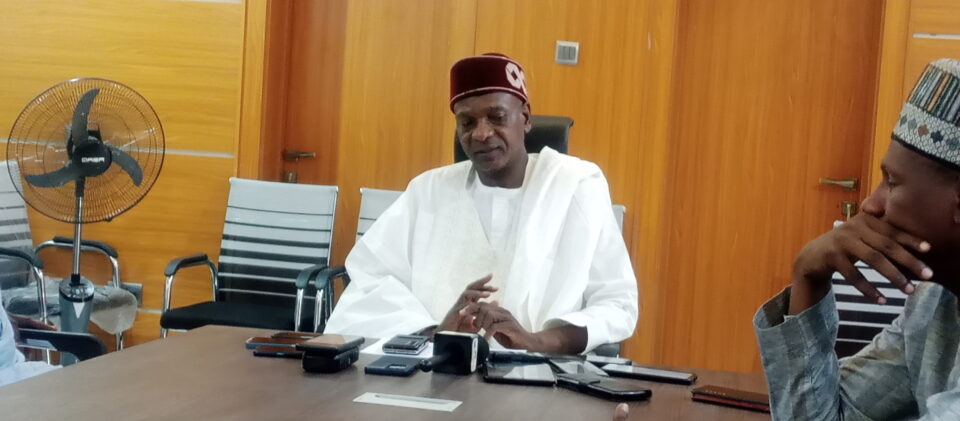
Dr. Danjuma Muhmud is the Commissioner for Agriculture in Kano State, in this Interview explained in details the Government of Alhaji Abba Kabir Yusuf intervention of Agricultural Projects, showcasing hundreds of achieved Agricultural activities in Kano including the creation of 11 Mini Irrigation sites and 11 Dams.
What was your first intervention on Agriculture As You Assumed Office?
The issue of livestock at that point in time, and even the issue of networking with our partners, be it development partners, be it INGOs, or the federal government of Nigeria. So the first thing we did was to establish the farmers database, to know the number of farmers that we have, so that that could inform our planning process.
When the government is budgeting, it has a near-accurate number of who is a farmer in the state, and that could be built into any plan that the state governments want to implement.And the same thing with giving near-accurate information to our partners, including the federal government of Nigeria.
So we’re able to aggregate and generate farmers’ data, which we’re able to filter, and we know away the noisy component of the data by just running it, and the responses we received, which allowed us to have the farmers’ data that we impute in our overall database.
And we now try to establish what we have on ground when it comes to crop production.We reviewed the status of all our irrigation facilities, and we now come to the conclusion that we need to make a very quick intervention in the areas of channels, rehabilitation, especially in our major irrigation sites that include Jermambaka, that include our FC at Kadawa, that includes our Bunkure A, Bunkure B, and a couple of other small irrigation facilities.
So in that regard, we requested for some money, and His Excellency the Governor graciously approved the monies that was given to us to rehabilitate some of the dilapidated irrigation infrastructure that we met. In that regard, we’re able to reclaim a substantial number of irrigation irrigatable land because of one minor disillusion that we have clearing the channels as well as rehabilitation of the canals.We’re able to recover over 1,200 acres of land that were put into use.
And we work with the federal government and African Development Bank project as well called ATAPS, which equally help us to recover over 200 acres of land that’s ready for irrigation.
So in that regard, we are ready and we’re able to distribute this farmland to our teaming farmers.We did the same thing, you know, in the area of animal husbandry at that time. The livestock company was with us as well. And we took assessment of the number of slaughterhouses that we have and what our veterinary clinics, the situation of our veterinary clinics.
More importantly, as I’ve told you at the beginning, we are working with some of these development partners and we were able to reach out to almost all of them.
Was There Any Donor Agencies Intervention?
The Islamic Development Bank, which has a huge intervention in the state, the World Bank, as well as IFAD. So we galvanized support from these, that angle.And they’re assured us that they will continue to provide support to the state. And we assured them that we’re going to play by the rules as far as international financial intermediation is concerned.
Talk to Us About Irrigation Farming And the Government Intervention?
We realized that when it comes to irrigation, we realized the number of sites that we have for irrigation is too small.So we embarked on some giant, and of course, small irrigation projects.
These irrigation projects include the giant, the giant irrigation project we are now doing at Donsushia, where we have a dam that has a length of about two kilometers and that will contain about three billion cubic liters of waters. You know, in that site.And we provided irrigation channelized sites that you could get about 500 hectares of irrigatable land, which translates to some 1,250 acres at Donsushia.
Currently, as I’m talking to you, because of the difficulty of accessing the area, His Excellency, the governor, you know, directed us to provide, you know, a road, a 14 kilometer road, that will allow our heavy equipment to cross to the site. As I’m talking to you, that road, 14 kilometer road, is completed.And the irrigation, the dam site is almost 40% completed now. While the irrigation channels, we have some review on it to expand it beyond what the initial scope was.
And they have equally gone far in that regard.Besides this giant irrigation site at Donsushia, we came up in line with the blueprint of His Excellency, the governor. We came up with another 11 mini irrigation sites as well as dams in 11 local governments. And these local governments include Anibasu, Kibia, Sumaila, Dogua, Shanono, Dawaikin kudu, Jajai, Irogu, Dichi, Dawakin Tofa, as well as Ngugu.So we’re able to at least secure approval from the council that we could go ahead with this project.
And right now, in fact, we’ve paid, we’re giving monies for compensations, at least in six of the 11 sites. While we’re still reviewing our details in terms of who gets what, before we put forward a request for compensation payment for council to approve.Some of the contractors are already on site, especially that of Anibasu.
It’s gone far because compensation has been paid and the contractors mobilized to the site. Once these 11 dams and the irrigation facilities are completed, we will have additional, maybe about 2,000 more acres of cultivable irrigated land in the state.That will prevent, help us to stop the influx of people from the hinterland, from the villages to the city, you know, in search of jobs.
And that will help to reduce poverty, you know, create income and means of livelihood for the, for our team and population. One interesting thing with some of this intervention that we received from the development partners is, you know, that of IFAD, it has some special focus on these three issues.Rurality, smallholder farmers, as well as women, more women for cost.
And that could really help us a lot in boosting the income of our populace, as well as boosting the food security in the state. Someone will wonder that, okay, you are making all this effort.What are we doing in terms of modernizing agriculture, you know?
So in that regard, we were able to generate a huge number of modern farm implements. And these implements cut across all the implements that you can think about, from tractors, treasures, forklifts, combined harvesters, solar irrigation pumps, planters and transplanters, you know, among others. And we equally have provision, again, with the support of the development partners, really, to provide small and medium-sized rice mills.
The small rice mill is much more women-focused, while the large rice mill is focused on the large producers, so that His Excellency, the Governor, plans to support cooperatives, registered cooperatives. It’s not a matter of giving somebody to harvest his produce and now to have redundant assets in the next farming cycle.
But it’s meant for cooperatives, registered cooperatives, genuine cooperatives that will be supported.And it’s important to tell you, this support, we just need a few things. We need very strong corporate governance from the cooperatives. We need, you know, establishment of the rule of law.
At least it’s well-grounded and it has election cycles, you know, as a cooperative, you know, so that at the end of the day, His Excellency, the Governor, plans to give these modern farm implements to these cooperatives free. It’s not for them to pay the government any money. But be serious, show seriousness, and be business-oriented and business-like in your dealings.We’ll do our checks, as our development partners required us to do.
But again, this support is for them to, you know, be strong and be able to help the state in our own quest to be food-secured. It’s also equally important to let you know that we also have down the line phobiety reduction support.You know, in the ministry, especially from the development partners’ side, the state gave its own counterpart money, and the development partners provided us with matching money in which, overall, in the last two, three years, we provided our teaming population with about 7,800 cows, whereby an individual will be given this 7,000 plus. It’s the number of participants, because if you multiply that by two, someone that is given two bulls to fatten, that translates to over 14,000.
And these bulls are given with animal feed, as well as drugs, medicine, that will help the fattening process.You fatten, we’re not expecting anything from you, you fatten and sell and continue to buy another one to continue to fatten to support your family.
The same thing with goats. Goats are mainly women.You know, we targeted women for the goats. Out of our maybe over 13,000 beneficiaries combined from the beginning of the projects to the end, each woman was given about three goats for reproduction. While we have another segment that target the youth, whereby young men were given two rams and, of course, animal feed, as well as drugs for fattening as well.So that’s in that regard.
So we also supported our farmers with additional inputs. Quality seeds as well as, but more importantly, fertilizers.And we received good support from the federal government, massive support from the federal government as well.
Say something about Procurement and Distribution of Fertilizer?
For the state government, over the last three years, the state government, as well as the local government, procured almost 700 trucks of fertilizers for distribution across the 54 local governments.
And we also, at a point, that was in 2024, His Excellency, the governor, procured over 54 trucks from KASCO.That’s our state-owned company, fertilizer company, which was distributed free to these farmers. To help the state, the federal government equally, in December 2024, gave the state about 70 trucks of fertilizers that combined urea, you know, about 30 trucks that we converted from Port Harcourt, then MPK 2010 that we converted from Mina in Niger State, and SSP, some trucks, too, of SSP that were given to us, which we converted to the state from Kaduna State.
The federal government has its own support program, whereby they use the data, farmers’ data that we gave them, in which they send SMS to our farmers for them to redeem some fertilizers, maybe sometimes four bags of fertilizers, pesticide, insecticides, and some seeds in different redemption locations.And we’re very grateful for the federal government of Nigeria in that regard.
And there was a time when we had attacks of bats, especially the quiller bats that attacked our farmlands, especially that came from the Ube State site, and we’re very grateful to the federal government.
They sent helicopters for spray, which helped to put the bats at bay, and of course, expel the bats from the state.We have achieved a lot in terms of our uncompleted projects from milk collection centers that we have completed over 70 now.
These milk collection centers are to help our Fulani compatriots. Instead of taking raw milk in an unhygienic position to be taken into the markets, the Islam Duran Bank, with the support of the state, helped us to establish this number of milk collection centers.
And each collection center is provided with a very magnificent building, a huge storage facility whereby the milk will not be allowed to be fermented unless it will be stored in a very cool place, as well as a solar facility that will keep the solar system or the cooling system running.
And we are about to distribute milk conveyance cans to all the milk collection centers. We are ready.We have them on ground right now, ready.
And we also completed a number of storage facilities, whereby if you convey your produce from the farmland, you know you’re going to take it to an aggregation center and storage facilities. We have these aggregation facilities across almost all the local governments.Almost all the local governments.
And again, to help our traders, we upgraded our cattle markets, especially the cattle market that is at Dumbulu, the cattle market at Falgori, the cattle market at Gorzo, the cattle market at Udil, at Lambata, and a number of other places.
These cattle markets, we upgraded them and we provided them with a water system, loading and boarding system, a veterinary clinic, a solar light, a drainage facility, and a ramp whereby instead of throwing the cows into a vehicle, you have a ramming system whereby the animals can easily be rammed into the trailers before being convinced to the south or east of the Niger.
Again, for our grain markets in Dawano, we’ve upgraded that, provided drainages, roads, a police station, solar facility, a good water system, among others. So we have achieved that and most of this, almost all of this project are completed. One important thing that I want to let you know is when you produce, you need to evacuate.Convey to the market or to aggregation centers or storage facilities.
In that regard, the state government, in conjunction with the Islamic Development Bank, has provided about 72 kilometers of farmland roads. They are tarred roads, not really feeder roads that have that right.No, at least they have surface dressing in a number of locations.
And some of these locations include Gora, Modugi, Daning, Garko, Danguziri in Rogo, Wase, Baita in Menjiburu local government, Dugal, Dambata, Dugal in Dambata local government, of course Milgoma, Yankatsari town, as well as a number of other roads that will help to evacuate farm produce to these aggregation centers. In terms of expanding the frontiers of cultivable land, we’ve also achieved a lot.We have expanded our farmlands and we have secured our FC that is about 480 acres. That’s before, not with the state government. We brought it back to the folder of the state government.
And again, the ministry, having merged the irrigation department of the Ministry of Water Resources, back to the Ministry of Agriculture, we have also expanded our own irrigation facility because we have irrigation facilities now at Thomas, Dambata, as well as Jikaradi, among other few places. So this is more or less, so far we’ve gone.
But one important thing again, once again, that I want to reiterate is that intractable problem, you know, of clash between farmers and headers, we’re able to make a huge road in that regard.
Our project provided a demarcated cattle route that has a length of about 1,270 kilometers across the state. So that’s why you now hear that clash between headers and farmers has gone to the barest minimum now in Kano State


